

Clearer, simpler and more inclusive communication for residents, visitors and staff maintains dignity.
Hearing loss is close to universal in residential aged care. When someone cannot follow what is happening in the lounge, they stop coming to the lounge. Communication technology here is not an amenity. It is the difference between participation and withdrawal.
What staff and families tell us
Residents stop attending activities they used to enjoy.
The television volume is a constant source of friction.
Announcements are missed, so staff repeat them in person.
Families notice a relative withdrawing and assume it is cognitive.
The chapel or activity room was never set up for hearing access.
Nobody is confident the existing system still works.
Withdrawal is often mistaken for decline. Sometimes the person simply cannot hear the room. Many studies have now shown a strong link between unassisted hearing loss and cognition.
What we design, install and support for aged care
Shared spaces, entrances and staff communication are usually handled piecemeal. We cover the whole environment.
Shared Space Audio & Vision
Lounges, chapels, activity rooms and cinema spaces. Television, presentation and shared listening designed for a room where hearing ability varies enormously.
Public Address & Paging
Zoned announcements and paging that reach the right area without a building-wide broadcast into resident rooms.
Hearing Augmentation & Inclusion
Loops, Auracast and assistive listening for lounges, chapels, reception and interview rooms, with coverage mapped, verified and signed.
CCTV & Access Control
Licensed capability, with resident privacy, consent and dignity addressed at design stage rather than after installation.
Reception & Interview Rooms
The spaces where families have difficult conversations, set up so nobody has to ask for anything to be repeated.
Design, Install & Support
Site review, specification, installation, commissioning, staff training, documentation and ongoing service. The same team before and after handover.
Soft rooms, quiet voices, competing sound
Why aged care spaces are difficult
Communal lounges are furnished for comfort, which helps acoustically, but they run several things at once. A television, a conversation, a trolley, another television in the next room. Age-related hearing loss makes separating a voice from that background far harder than simply hearing it.
What we design for
Clarity at conversational level rather than volume. Zoning so the lounge, the chapel and the activity room can run independently. And hearing access delivered directly to a resident's own hearing device, so the room does not have to get louder for one person to follow it.
Dignity is a design decision
How hearing access is delivered matters as much as whether it exists.
Systems that single people out
A resident who has to ask staff for a receiver, wear a visible neck-worn device, or sit in a designated seat is being marked out in front of their peers. Many will simply decline and stay in their room.
Systems that do not
A permanently installed loop, or a broadcast a resident joins through their own hearing aid or earbuds, needs no request, no equipment and no announcement. Nobody else in the room has to know.
Why this matters under the strengthened Quality Standards
The seven strengthened Aged Care Quality Standards took effect on 1 November 2025 under the Aged Care Act 2024. Standard 1 is built around dignity, respect and identity. Standard 3 covers care tailored to the individual, including communication. Standard 4 covers the organisation's service environment and requires it to be safe, supportive and to meet residents' needs. A resident who cannot follow what happens in a shared space is not being supported to participate in it.
What may apply to your facility
Aged care sits under both care and building frameworks. We help identify which apply before the scope is locked.
Strengthened Aged Care Quality Standards
In effect since 1 November 2025 under the Aged Care Act 2024 and Aged Care Rules 2025. Standard 1 addresses dignity, respect and identity. Standard 3 addresses care tailored to the individual, including communication. Standard 4 addresses the service environment.
NCC 2025, Part D4 and Class 9c
Residential aged care buildings are Class 9c. Clause D4D8 addresses hearing augmentation where an inbuilt amplification system is installed, other than one used only for emergency warning. Induction loops must cover at least 80% of the floor area served; receiver-based systems at least 95%. Clause D4D7 covers the Braille and tactile signage identifying the space.
AS 1428.5
The 2021 edition aligns with the international IEC 60118-4 standard on field strength and coverage, requires coverage to be mapped rather than assumed, and requires wheelchair seating areas to be covered.
Privacy, network and security
Cameras, access control and connected devices in a residential setting carry privacy and consent considerations that belong in the design conversation, not the handover.
Requirements vary by facility, jurisdiction, building classification and approval pathway. A compliance check identifies what is likely to apply to your site.
Where it matters most
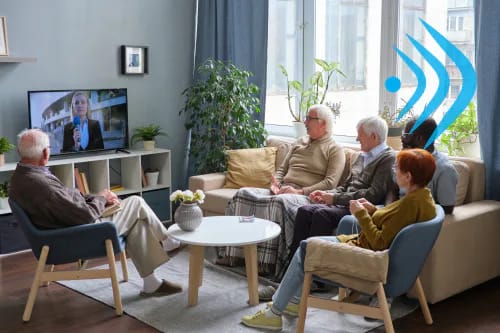
Communal Lounges
Everyone in the room can follow what is happening.
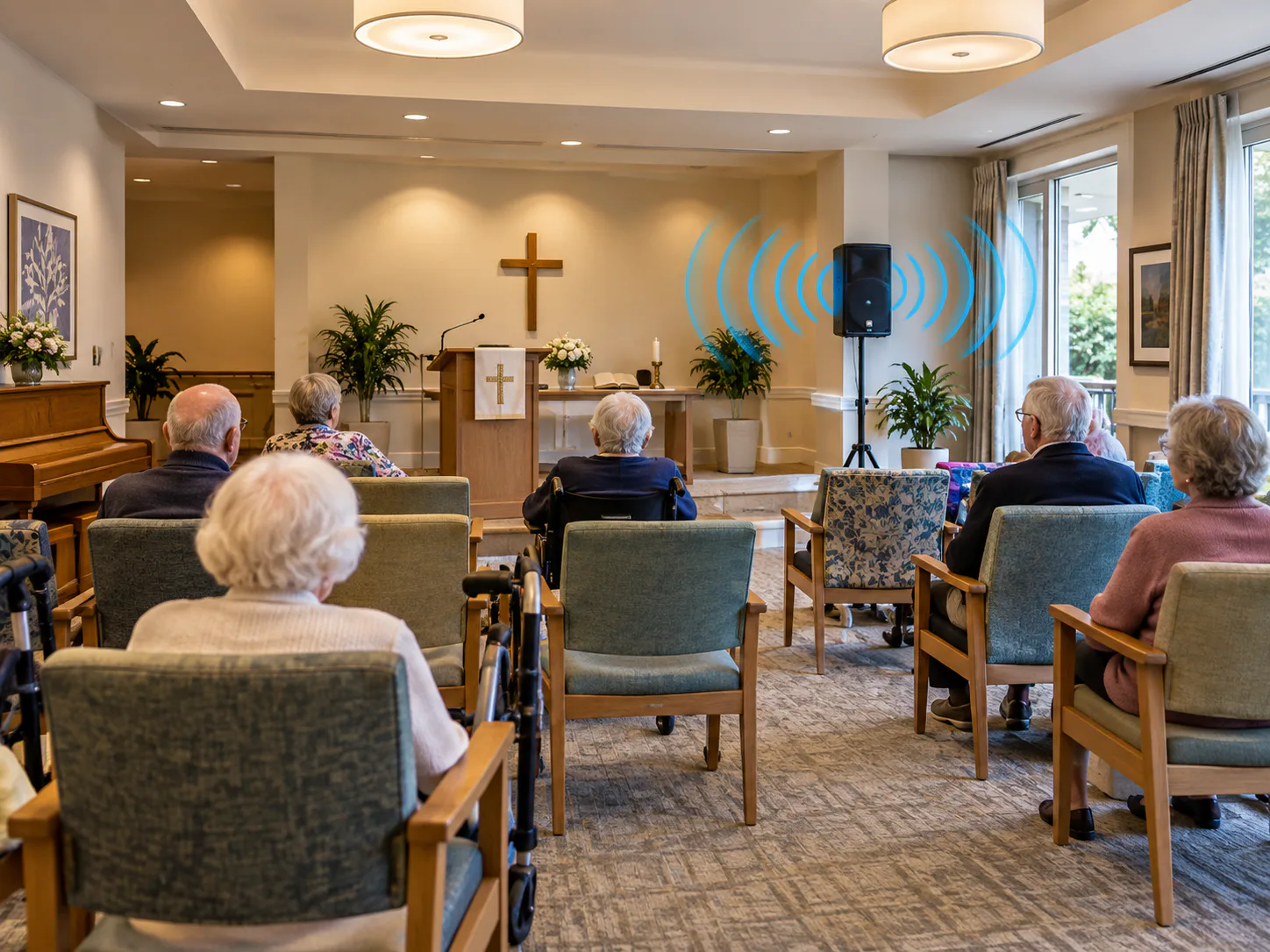
Chapels and Activity Rooms
Services and activities that include everyone present.
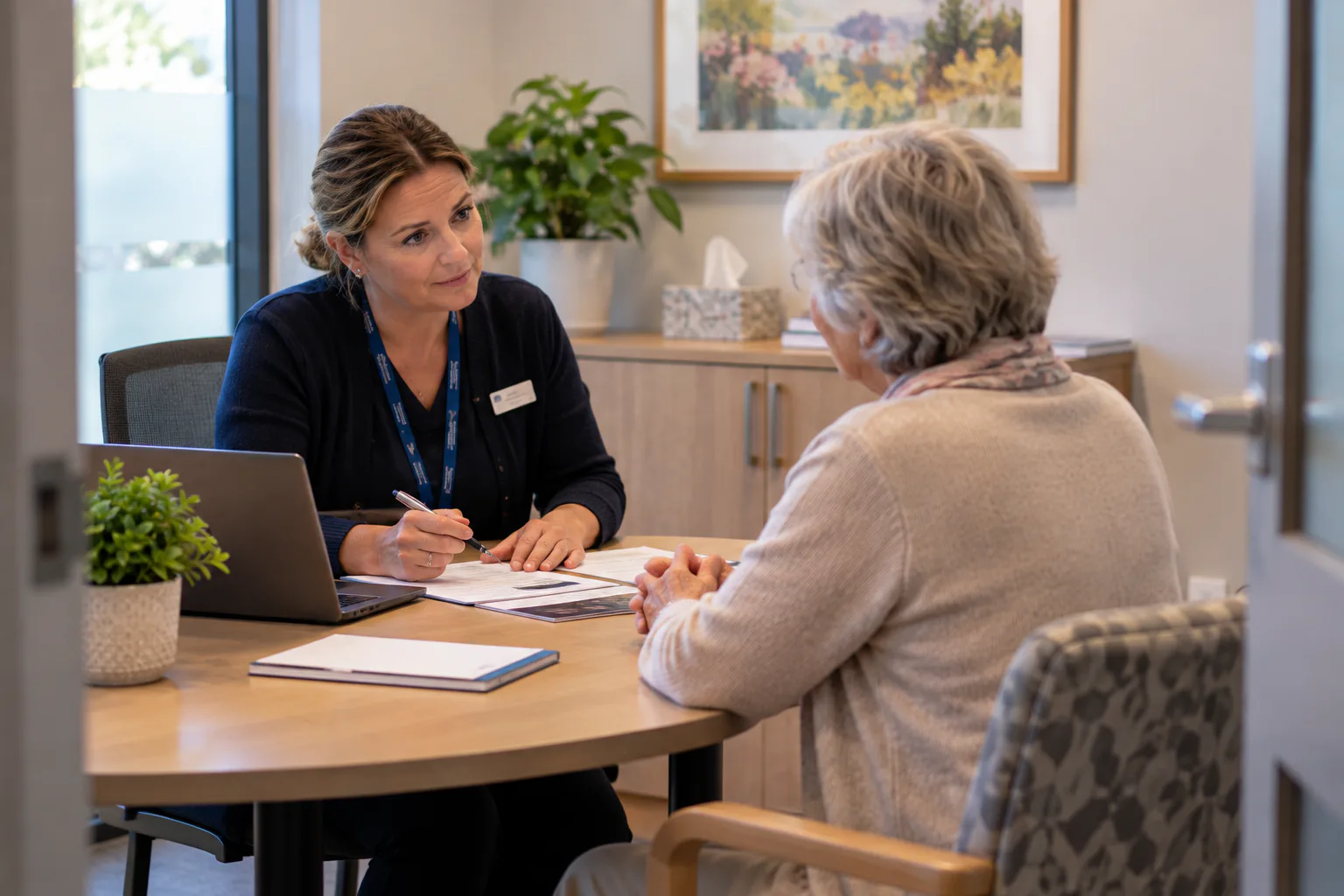
Reception and Interview Rooms
Difficult conversations that do not have to be repeated.
The resident's own hearing aid becomes the speaker.
Auracast broadcasts audio directly to a resident's own hearing aids, earbuds or phone. No receiver to collect, no device to charge, nothing to lose. In a communal lounge it means the television can sit at a comfortable volume for the room while a resident with hearing loss hears it clearly.
Adoption depends on the devices residents already have, so we will tell you plainly where it fits today and where a loop is still the better answer.
Speak to Clearasound About Auracast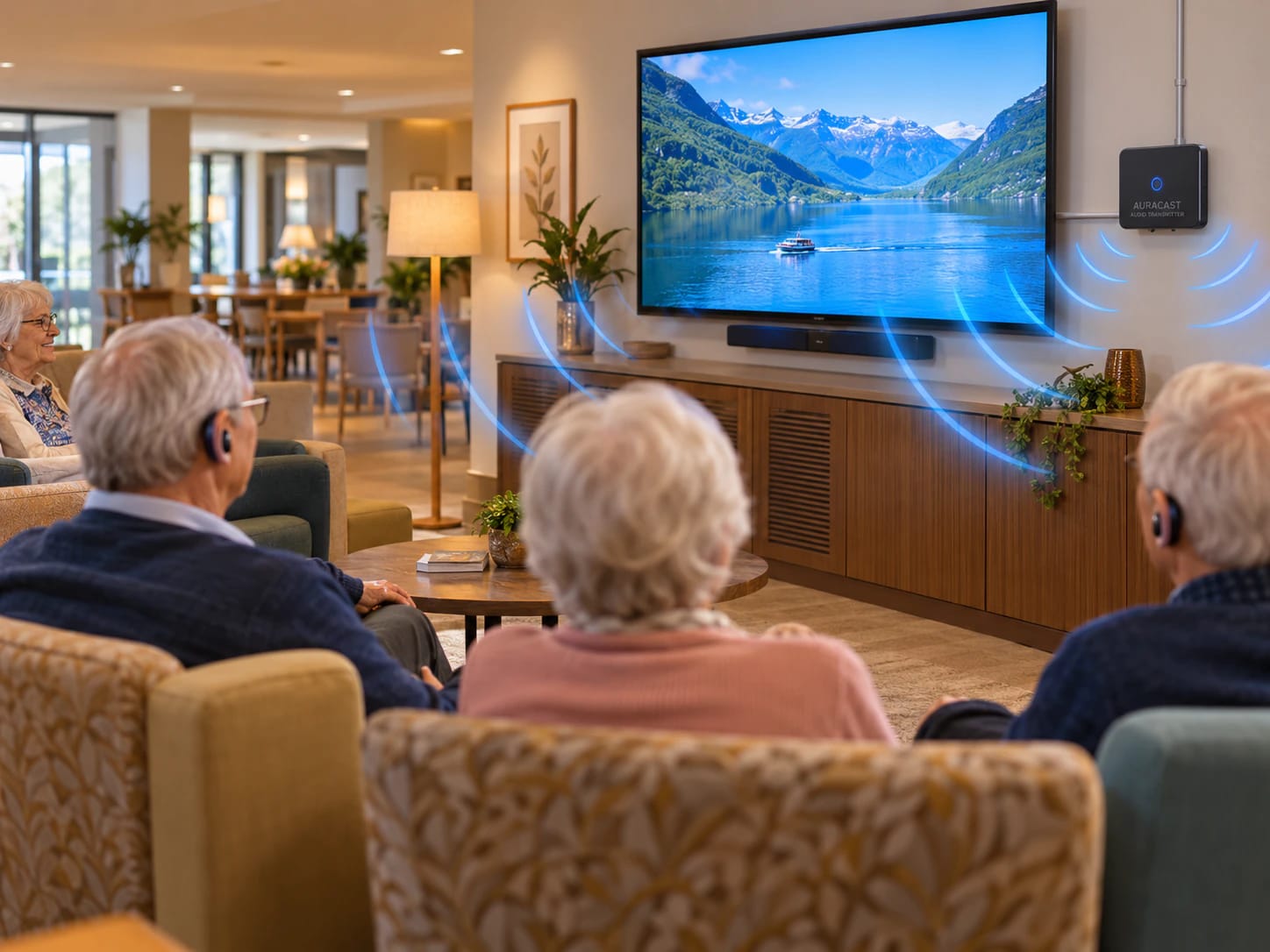
Built for the people who have to sign it off
Aged care decisions cross several teams. We are used to working with all of them.
Facility and operations managers
Systems staff can run on a weekend shift without a manual.
Executive and clinical governance
A defensible link between the system and the strengthened Quality Standards.
ICT and security
Network-aware design, documented configuration and licensed CCTV and access capability.
Procurement
A specification that can be compared on resident outcomes, not equipment lists.
Traps to avoid in aged care projects
Assuming hearing augmentation is required everywhere. Or assuming it is not required anywhere.
Overlooking reception counters, interview rooms, activity spaces and multipurpose rooms.
Choosing a system that requires residents to ask for equipment, which they find too hard or embarrassing.
Installing hearing augmentation and never testing whether residents can actually use it.
Training one staff member, then rostering a different team on weekends.
Adding cameras, access control or shared-space audio without addressing privacy, dignity and consent.
Compliance, reliability and usability considered from the start.
Compliance and StandardsWe understand real-world challenges, and how to solve them.
Start with one room, or review the whole facility.
Tell us which space is not working. We will help identify what your existing systems deliver today, what residents actually experience, and what it would take to close the gap.